1. Research Background and Methodology
1.1 Origins of the Problem: Household Registration Limits and Transportation Dilemmas
As the only megacity in China that has not yetlifted its restriction of hukou (household registration), Beijing enforces strict regulatory policies, resulting in unique phenomena. As of the end of
2023, Beijing’s permanent migrant population reached 8.24 million (accounting for 37.7% of all permanent residents), which means that one out of every three people did not have a Beijing hukou. This group faces two major problems:
● Education difficulties: Students without a Beijing hukou need to fit into the "nine categories" (such as having parents who hold a Beijing Work & Residence Permit) to attend the high school entrance examination. Otherwise, they can only be admitted by vocational high schools or return to their hukou origin to attend the national college entrance examination. Even when these students meet related conditions, they can only apply to higher vocational colleges when attending the national college entrance examination.
● Mobility difficulties: The number of non-local vehicles in Beijing for long-term use is
approximately 700,000. With the winning rate for a Beijing license plate lottery lower than 0.3%, many residents without a Beijing hukou must use out-of-province license plates and obtain entry permits to travel in Beijing.
Through on-site investigation, this report analyzes how Beijing's hukou system influences the allocation of urban space and resources, with a focus on the association between vehicle plate distribution and limited education opportunities.
1.2 Research Methods and Technical Framework
A mixed-methods approach is adopted in the study to conduct an on-site investigation in key communities outside the Fifth Ring Road of Beijing.
● Quantitative observation: Six communities, including Lucheng in Tongzhou and Tiantongyuan in
Changping, were chosen, where license plate data from parking lots and roads in different time periods were recorded (3,825 vehicles in total).
● In-depth interviews: Twelve vehicle owners without a Beijing hukou were interviewed, with questions covering educational choices, transportation strategies, and policy concerns.
● Policy analysis: The mutual influence between the Beijing Entry Permit System (2025)
and the Compulsory Education Enrollment Regulations (Beijing Education Standard
[2025] No. 3) was analyzed.
2. Residential Distribution of Non-Local License Plates
2.1 The Commuting Belt around Beijing: Surroundings of Lucheng Subway Station
The parking lot near Lucheng subway station in Tongzhou, an important commuting hub connecting Beijing, Tianjin, and Hebei, shows a pronounced concentration of non-local vehicles:
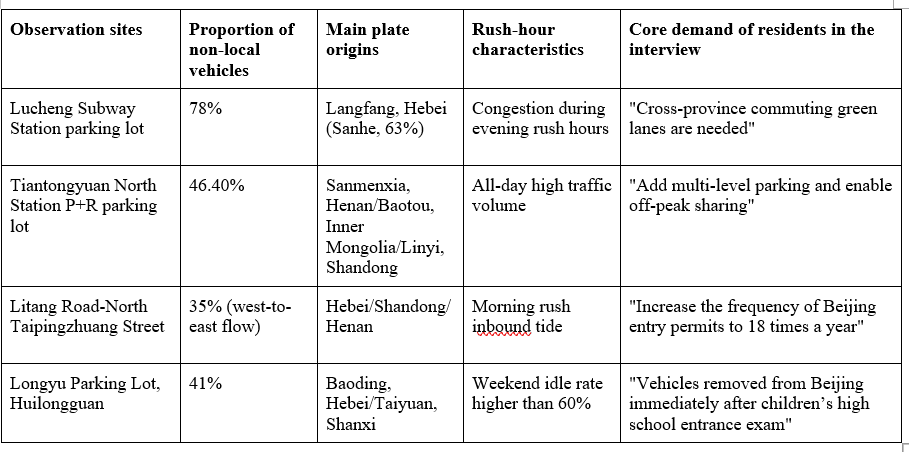
● High proportion: Of the 677 parking spaces, 78% were occupied by non-Beijing-plated
vehicles. Among them, vehicles with license plates from Langfang, Hebei Province (especially Sanhe) accounted for 63%.
● Tidal congestion: Non-local vehicles swarm into the flow of cross-provincial commuters during evening rush hours (18:00-19:30), making roadside parallel parking rates to surge by 200% and causing severe congestion.
A vehicle owner with a license plate rom Langfang, Hebei, said in an interview, "We have to drive from Yanjiao (a town in Sanhe), park at Lucheng Station, then take the subway to Guomao. It’s not that we don’t want a Beijing license plate. We haven't won the lottery for 8 years." The mode of living across
provincial borders while working in the city makes Lucheng a traffic hub for cross-provincial commuters.
2.2 Mega-Communities: The Parking Problem of Tiantongyuan
Tiantongyuan is nicknamed the biggest residentialcommunity in Asia. Its issues with non-local vehicles reflect severe insufficiencies in planning and policy.
● P+Rimbalance: Normally, non-local vehicles account for 46.4% of the 151 parking spaces in the park-and-ride lot at Tiantongyuan North Station. The proportion rises to 80% during peak hours.
● Severe illegal parking: Non-local vehicles account for over 70% of illegally parked vehicles on local roads, and residents complain that "finding a parking space is as hard as an archaeological expedition."
It can be concluded thatthe root cause lies in the long distance between workplaces and residences. At
present, those without a Beijing hukou account for 62% of the 350,000 residents in the region. The ratio of parking spaces per household in the community's early planning was 0.4:1, which is far lower than the current standard (1:1.2). A vehicle owner with a license plate registered in Hubei remarked, "My
child attends school in Beijing but can't take the national college entrance exam in Beijing. He must return to Hubei for junior high school. Now I only use the car to take my child for weekend tutoring."
On-site observation data of non-local vehicledistribution in key communities outside the Fifth Ring Road of Beijing (June 2025)
3. Transportation Plights under the Beijing EntryPermit System
3.1 Permit Restrictions
Beijing’s entry permit system is controlled and managed through temporal and spatial
restrictions.
● Spatial restrictions:
1. Permit for traveling within the Sixth Ring Road: A maximum of 12permits per vehicle per year, each lasting 7 days. The scope of coverage includes the entirety of Tongzhou and the urban areas of Yanqing.
2. Permit for traveling outside the Sixth Ring Road: Unlimited applications, but only outer suburbs, non-core zones are applicable.
● Temporal restrictions:
1. Vehicles with permits are still prohibited from entering core zones,such as roads within the Second Ring Road and Jianguomenwai Avenue.
2. Vehicles are not allowed to travel on the roadswithin the Fifth Ring Road during weekday rush hours (7:00-9:00, 17:00-20:00), reducing valid driving time by 40%.
A vehicle owner whose household registration is inHenan noted, "I have to use 65 of the 84 days permitted annually to drive in Beijing to take my child to school. The rest of the time, the car becomes
scrap metal, just parked there."
3.2 Permit Costs and Grey Industry Chains
The restriction causes illegal permit handling and a grey market for license
leasing.
● Document counterfeiting: In Yanjiao, "Beijing entry permit agents" claim to
"resolve non-local traffic violations and guarantee permits,"
charging 800-1,500 RMB per service.
● License plate leasing: The annual leasing fee of Langfang license plates reaches 3,000
RMB, and leasers are mainly Hebei families without a vehicle, which poses legal
ownership risks.
A more severe issue is restricted years of education. Interviews reveal that parents without a Beijing household registration generally dispose of their vehicles as their children enter junior high school. "The second year of junior high school is a threshold—either transfer to an international school or
return to the hometown with the car," a major dilemma.
4. The Division Between Household Registration and Education
4.1 Educational Policy Constraints
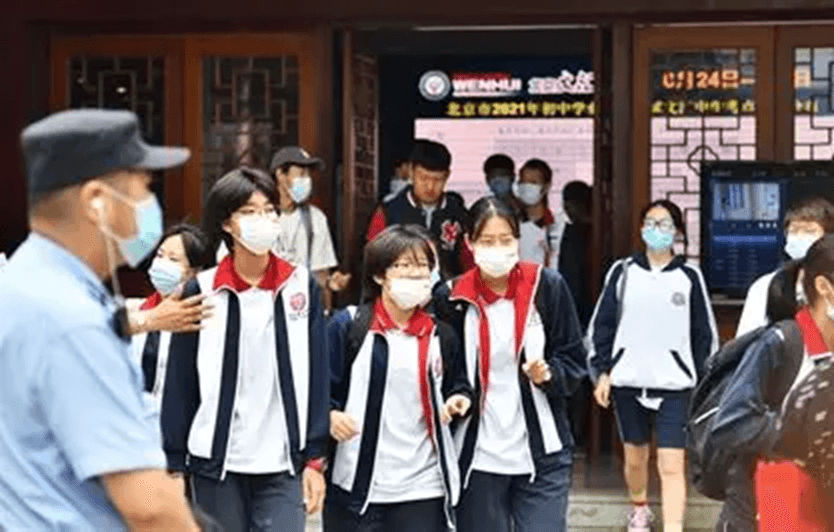
The admission requirements for students without a Beijing hukou was made stricter under
Beijing’s compulsory education policy in 2025 (JJJE [2025] No. 3):
● Strict requirements for social security: The location of parents' social security payments should be consistent with their place of residence; children lose admission eligibility if the social security is not paid for over three months.
● Strict requirements for house leases: Rental registration is mandatory; commercial apartments and illegally built houses are not recognized.
● Long duration requirements: Residence permits should be held continuously for one year, with verification completed eight months before admission.
These policies, combined with license platecontrols, make families without a Beijing hukou give up jobs in central districts and move to the suburbs, which leads to a longer commuting distance and exacerbates the need for non-local vehicle use.
4.2 The Cost of Educational Breakthrough
Facing difficulties in further education, families without a Beijing hukou develop four countermeasures, all tied to traffic behavior:
● Returning to the hukou origin (accounting for about 45%):
Transfer occurs before Grade 5, but mismatched textbooks (for example, a 32% difference between textbooks edited by People's Education Press in Beijing and those edited by the Hebei Education Press) force parents to drive to Beijing for children's weekend tutoring, resulting in "cross-provincial tutoring
traffic."
● Enrollment in Yanjiao (accounting for 30%):
Parents still work inBeijing while their children register in Hebei schools; daily commuting relies on Hebei-plated cars. In 2025, 750,000 students took the college entrance exam in Hebei, driving a 50% premium for middle school placements in Yanjiao.
● Obtain household registration in Tianjin (accounting for 15%):
Household registration can be obtained through the Haihe Talent Program. However, in 2025, the points threshold was raised to 120, and the number of students taking the high school entrance exam surged to 131,000 (an increase of 34% over five years), forcing parents to frequently drive between Tianjin and Beijing for house-hunting and social security arrangements.
● Internationalschools (accounting for 10%):
Privately-run international schools without hukou requirements can be chosen, with an average cost of 250,000-400,000 RMB per year. Some families turn their vehicles into ride-hailing cars to increase income.
5. Innovative Joint Governance of Education and Transport
Based on the investigation, solutions at three levels are hereby proposed.
● Flexiblehousehold registration:
1. Introduce a "Beijing-Tianjin-Hebei Commuter Hukou System":People who live in the three counties in northern Hebei and work in Beijing for over five consecutive years should be granted eligibility to enter the license plate lottery, and their children should be allowed to apply to vocational high schools in Beijing.
2. Establish an "Educational Contribution Points System":Years of social security payments should be converted into points for college entrance exam eligibility; 12 years would permit application to municipal undergraduate universities.
● Parking resource redistribution:
1. Repurposing idle space: Underused corners in communities likeTiantongyuan can be transformed into multi-level garages (for example, Ganmian Hutong in Dongcheng District improved parking capacity by 167%), and parking spaces should be specifically allocated to non-Beijing-plated vehicles.
2. Staggered time-sharing upgrade: Mandate state-owned enterprises' parking lots to open for
parking at a low-cost during nighttime (for example, the Beijing Public Transport Group offers 3,000 parking spaces) and introduce "community transport passes" (20 RMB per month, unlimited use).
● Cross-regionaleducational cooperation:
1. Establish Beijing-affiliated high school branches in Langfang andWuqing: Students without a Beijing hukou should be allowed to enroll through academic record transfers and apply to colleges based on Beijing's cut-off scores.
2. Launch "education commute routes": Cross-provincial schoolshuttles should operate between Yanjiao and Guomao, and Beijing B‑series license plates should not require a Beijing entry permit.
6. Conclusion: Make Urban Governance More Inclusive
In essence, the hardships associated with Beijing hukou and license plates reflect unequal distributions of space and rights. When car owners wait at dusk at Lucheng Subway Station to carpool back to Hebei, and international schools’ lights illuminate children without local registration, these regulations make
living costs increasingly higher.
This study shows that rigid administrative controls lead to questionable solutions. Limited education opportunities aggravate transport demand, and students who return to their hukou origin create periodic cross-provincial traffic. The key to solving these problems is to acknowledge certain rights of those without a Beijing hukou and allow a shift in policy focus. The following measures can be taken:
● Short term: Increase Beijing entry allowances to 18 times per year; certify P+R lots for nighttime residential use.
● Medium term: Pilot a "license plate-school enrollment" policy in Beijing, Tianjin, and Hebei; students studying in Beijing for up to nine years would be qualified to attend the college entrance exam.
● Long term: Reconstruct the job-residence relationship through rail integration in Beijing, Tianjin, and Hebei (such as opening the Pinggu Line), reducing institutional traveling needs.
Only by aligning the movement of vehicles with people's developmental paths and gradually shifting the focus of household registration policies toward non-economic objectives can everyone who contributes to the city have a promising future.