

Abstract
Euler’s formula, e^(ix) = cosx + i sin x, is often introduced as a beautiful equation. Beauty does not say what the equation is allowed to do. This article asks a narrower question: to what extent does the formula unify the exponential function with sine and cosine, and where does that unification stop once it is used to describe a
repeating signal? Unification is tested in three ways. It may connect two ideas, it may give them one systematic representation, and it may carry an operation from one representation to the other without changing the result.
Euler’s formula passes the second and third tests inside the complex numbers. It does not pass them on the real line, and it does not make the two kinds of function the same object. A playground swing of small amplitude, and the
50-hertz voltage at a household socket, can both be written as the real part of one complex exponential. A swing pulled through a large angle, a voice that starts and stops, and a supply that leaves its designed frequency cannot. The formula is a working language for steady repetition. It is not a description of every wave that a person meets.
1. Two motions that come back
A swing leaves the hand andcomes back. The voltage at a wall socket reverses, and it too comes back to the same point in its cycle. Public low-voltage systems are standardized at 50 or 60 hertz (International Electrotechnical Commission, 2009). The household supply in mainland China is a 50-hertz system, so the voltage pattern repeats fifty times a second. Neither motion looks like growth. A sum of money under continuous compound interest, or a hot drink cooling toward the temperature of the room, changes by a real exponential. Those quantities do not return to a
starting value on a fixed period.
The interest and the coolinguse e raised to a real number. The swing and the socket can be written with the same letter e, but the exponent is imaginary. Euler’s formula is the statement of that step:
e^(ix)= cos x + i sin x.
The formula is old, and ithas collected a reputation for beauty. Feynman, Leighton, and Sands (1963/2013), introducing it for the study of oscillating systems, call it “the most remarkable formula in mathematics” and “our jewel.” The reputation and the use are not the same thing. A formula can be admired and still be easy to overstate. This article follows the use. It asks how far the connection between the exponential and the trigonometric functions really goes, and then it stays with two signals that a reader can time: a swing one metre long, and one cycle of a 50-hertz supply.
2. Writing the identity, not praising it
One honest way to see theformula is to start from the series for the real exponential and substitute an imaginary input. For a real number x,
e^x =1 + x + x^2/2! + x^3/3! + x^4/4! + x^5/5! + ···
Replace x by ix. The powersof i alternate: i^1 = i, i^2 = −1, i^3 = −i, i^4 = 1, and then the pattern repeats. The series splits into a real part and an imaginary part:
e^(ix)= (1 − x^2/2! + x^4/4! − ···) + i (x − x^3/3! + x^5/5! − ···).
The bracket without i is theseries for cos x. The bracket multiplied by i is the series for sin x.
Therefore
e^(ix)= cos x + i sin x.
The derivation mattersbecause it shows where the trigonometric functions enter. They are not pasted onto the exponential by a definition invented for the occasion. They are what the exponential series becomes when the input is imaginary.
Two rearrangements are usedconstantly, and both can be reversed:
cos x= (e^(ix) + e^(−ix)) / 2,
sin x= (e^(ix) − e^(−ix)) / (2i).
From the first form of theidentity, the special case x = π gives e^(iπ) + 1 = 0. That special case is the line readers ranked highest for beauty in a small survey reported by Wells (1990): an average score of 7.7 from 68 responses. Wells’s own conclusion was cautious. The survey was crude, and he wrote that no strong claim about agreement among mathematicians should be drawn from it. A first-place score is a fact about that questionnaire. It is not evidence that exponential and trigonometric functions have become one function.
The geometry is simpler thanthe reputation. On the unit circle, the point at angle x, measured in radians from the positive horizontal axis, has coordinates (cos x, sin x). Those coordinates are the real and imaginary parts of e^(ix). Multiplying by e^(ix) rotates a complex number through the angle x. A full turn increases the angle by 2π, and both sine and cosine return to the same values. Their period is 2π, not π/2. The shorter number is a quarter turn. It will matter later, because a quarter of a household cycle is a useful delay, but it is not the period of the functions. Figure 1 puts the two pictures used in the rest of the article side by side: the point on the unit circle, and one cycle of a 50-hertz cosine.
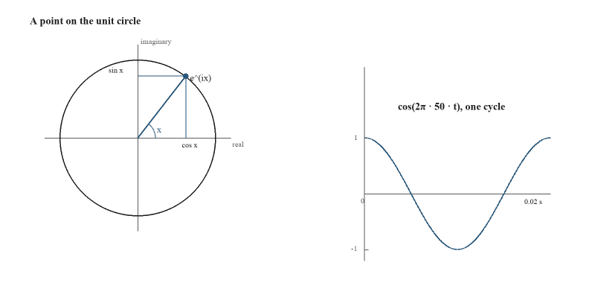
Figure 1. Left: the value e^(ix) as a point onthe unit circle. Right: one cycle of a 50 Hz cosine, lasting 0.02 seconds.
3. What unification is being claimed
A connection is not, byitself, a unification. Two functions can appear in one equation and still do different work. Here, unification means that a common framework lets the functions be understood together, written in one language, and operated on so that the result can be translated back. The three tests are conceptual, representational, and operational. They measure extent. A formula can pass one test and fail another.
The conceptual test askswhether two ideas that look unrelated sit inside one structure. On the real numbers, the exponential function describes growth, decay, and continuous compounding. Sine and cosine describe periodic motion and the coordinates of a rotation. Euler’s formula says that the second behaviour appears when the exponent of the first function is imaginary. That is a real change of interpretation, not a play on words. It is also limited. For real x, e^x is not periodic. Sine and cosine are. The formula does not remove that difference. It shows that the difference depends on staying on the real line.
The representational testasks whether each side can be rewritten as the other by a rule, and whether the rule runs in both directions. The two rearrangements in Section 2 do that for sine and cosine. An expression in e^(ix) can be split into a cosine and a sine, and a cosine or a sine can be rebuilt from exponentials. This is stronger than a resemblance. It is a translation.
There is a fair objection. Atranslation might only be a change of notation. If sin x and cos x keep their usual properties after they are written with e^(ix), nothing has been unified except the symbols. The objection holds if no operation survives the translation. It fails if an operation performed on one side agrees, after translation, with the same operation performed on the other side. That is the operational test.
4. One operation, done on both sides
Differentiate the exponentialform. The ordinary rule for a constant multiple in the exponent gives
d/dx[ e^(ix) ] = i e^(ix).
Replace e^(ix) by cos x + isin x:
ie^(ix) = i (cos x + i sin x) = i cos x − sin x.
Now differentiate thetrigonometric form directly:
d/dx[ cos x + i sin x ] = −sin x + i cos x.
The two results are the same.Differentiation does not care which way the quantity was written. The representations are not two names for a static fact. An operation passes from one to the other and returns the same value.
A second operation is raisingto a positive integer power. From the formula,
(cosθ + i sin θ)^n = (e^(iθ))^n = e^(inθ) = cos(nθ) + i sin(nθ).
This is De Moivre’s theoremfor a positive integer n. In the trigonometric form, the power means multiplying a bracket by itself n times. In the exponential form, it means multiplying the angle by n. The second job is shorter, and it gives the same complex number. A single numerical check is enough to see the agreement. At θ =
π/3,
cos(π/3)+ i sin(π/3) = 1/2 + i √3/2.
De Moivre’s theorem squaresthis by doubling the angle. The result is cos(2π/3) + i sin(2π/3) = −1/2 + i
√3/2. Multiplying the original complex number by itself gives
(1/2+ i √3/2)^2 = 1/4 + i √3/2 + (i √3/2)^2 = 1/4 + i √3/2 − 3/4 = −1/2 + i √3/2.
The two routes meet. Theshortening is the practical content of the unification. It is not a proof that every trigonometric problem becomes easy.
Tangent is already a warning.Because tan x = sin x / cos x, its exponential form is a quotient, and the quotient is undefined wherever cos x = 0, that is, at x = π/2 + kπ for an integer k. The breaks in the tangent function are still there after the translation. A unification of sine and cosine does not automatically extend to every
function built from them.
The same caution applies ifone leaves the classical formula for a wider algebraic pattern. Iordănescu, Nichita, and Păsărescu (2020) study
e^(zJ)= c(z) I + s(z) J,
where J is a matrix whosesquare is a constant times the identity, and the companion functions c and s obey addition rules of the same family as cosine and sine. When J is i times the identity, the classical formula returns. When that constant is positive, the same pattern produces the hyperbolic cosine and sine. The paper is a genuine extension. It shows that “an exponential, together with a pair of companion functions” is a broader shape than one identity. It does not show that the identity taught in school unifies matrix algebra, coalgebras, or the Yang–Baxter equation. Those structures are where the generalisation lives. A circuit or a swing does not pass through them. Treating the generalisation as if it enlarged the school formula would confuse a theorem with its cousins.
Hyperbolic cosine does markthe boundary that the imaginary unit creates. The real exponential pairs with cosh and sinh, and those functions do not oscillate. A uniform chain hanging under its own weight takes the shape of a hyperbolic cosine: it spreads and stays. Cosine, and the return of a swing, appear when the exponent is imaginary. The shared object is the exponential function. Periodicity is the special case, not the general behaviour.
5. The swing and the socket
The tests above are stillinside pure mathematics. The further question is what a familiar device does with the result, and where the result stops describing the device. Two calculations are enough, and both can be repeated with a calculator.
For a simple pendulum oflength L, the angle θ from the vertical satisfies, while the angle remains small,
θ'' +(g/L) θ = 0.
The coefficient g/L ispositive, so the solutions oscillate. If the swing is released from rest at an angle θ_0, one solution is
θ(t)= θ_0 cos(ωt), ω = √(g/L).
By Euler’s formula, thiscosine is the real part of θ_0 e^(iωt). The motion returns to the same angle when ωt increases by 2π, so the period is
T =2π √(L/g).
Take L = 1 metre and g = 9.8metres per second squared. Then T = 2π √(1/9.8) ≈ 2.01 seconds. Lengthening the rope lengthens the period. The mass of the rider does not appear. Both facts follow from the equation. The exponential form is a way to write the cosine that solves it, not a second physical cause.
The equation itself is thelimit. It replaces sin θ by θ, and that replacement is legitimate only while θ is small and measured in radians. At 30 degrees, θ is about 0.524 radians, while sin θ is 0.5. The two numbers have already separated, and the period of a real swing then depends on how far it is pulled. Euler’s formula has not become false. The cosine has stopped being the exact solution of the physical problem. A swing pulled high is outside the working range, even though the same rope is still there.
The household voltage is thesame mathematics at a frequency no one would time with a stopwatch. One cycle may be written
v(t)= V_0 cos(2π · 50 · t) = Re( V_0 e^(iωt) ), ω = 100π.
The period is 1/50 of asecond, or 0.02 seconds. A quarter of that cycle is 0.005 seconds, and a quarter cycle is multiplication by i, because i = e^(iπ/2). In circuit calculations this complex form is called a phasor (Alexander & Sadiku, 2017). Two supplies of the same frequency, the second a quarter cycle behind the first, have the sum
Acos(ωt) + B cos(ωt − π/2) = A cos(ωt) + B sin(ωt).
In the exponential languagethe same sum is the real part of (A − iB) e^(iωt). Adding the signals is one arithmetic operation on a pair of fixed complex numbers. The time-dependent cosine is restored only at the end, by keeping the real part. This is the operational test in the setting it was built for. Feynman, Leighton, and Sands introduce the formula because oscillating systems are about to be discussed, not because the identity looks surprising on a page.
The convenience has acondition. The two supplies must share one frequency, and that frequency must be steady. A fault, a sudden change of load, or a waveform bent by the equipment attached to it is not one term of the form V_0 e^(iωt). The calculation then needs further terms, or it has to leave the phasor method. The identity does not fail as algebra. The socket has left the situation the identity describes. For the person using the supply, that departure is a
practical event: a flicker, a breaker that opens, a device that no longer sees the cycle it was designed for. The formula does not decide how electricity is priced, or who loses power first. It does say, in advance, which kind of event still belongs to a single rotating complex number and which kind does not.
6. A tone is one term; a voice is not
A tuning fork near the note Aabove middle C vibrates at 440 hertz. Its ideal displacement is a single cosine, with period 1/440 of a second, about 0.00227 seconds. The ear meets the real part of a complex exponential, just as the swing and the socket do. Textbooks of signals take that exponential, rather than sine and cosine separately, as the basic signal, because a delay or a sum of steady oscillations stays easy to write (Oppenheim, Willsky, & Nawab, 1997).
A voice is not a tuning fork.Speech starts, stops, and changes pitch. A recording can be analysed as a sum of steady cosines, but the sum is a model over an interval that the analyst chose, and the interval is part of the method. Euler’s formula governs each term that is genuinely steady. It does not, by itself, choose the interval, remove noise, or decide whose speech is carried. Those choices sit in the apparatus and in the arrangements around it. The mathematical boundary is the one already met. A single complex exponential describes a steady repetition. The moment the sound refuses to repeat, the description needs more than the identity.
7. Conclusion
Euler’s formula unifies theexponential function with sine and cosine to a definite and limited extent. Conceptually, an imaginary exponent turns the interpretation from growth to rotation, and it does so only by leaving the real line. Representationally, sine and cosine can be rebuilt from complex exponentials, and the rebuilding can be reversed. Operationally, differentiation and positive integer powers agree on both sides. That agreement is why a phase shift, and a sum of steady signals of one frequency, can be done with complex arithmetic and translated back at the end.
The unification stops inplaces that can be named. It does not make the real exponential periodic. It does not remove the breaks in the tangent. It does not turn a matrix generalisation into a reason to say that the classical formula unifies every field in which a cousin of the formula appears. And it does not describe a motion that has stopped being a steady cosine: a swing pulled too far, a supply knocked off its designed cycle, or a voice that begins and ends.
The last of these limits isthe one with consequences outside mathematics. Technologies that carry a repeating signal are built on the case the formula handles well. When the case changes, the identity has nothing further to say, and the remaining problem belongs to the machine and to the people waiting on it. The formula is powerful inside its condition. The condition is part of the result.
References
Alexander,C. K., & Sadiku, M. N. O. (2017). Fundamentals of electric circuits (6th ed.). McGraw-Hill.
Feynman,R. P., Leighton, R. B., & Sands, M. (2013). The Feynman lectures on physics (New millennium ed., Vol. I, Chapter 22). Basic Books. https://www.feynmanlectures.caltech.edu/I_22.html (Original work published
1963)
InternationalElectrotechnical Commission. (2009). IEC 60038:2009, IEC standard voltages.
Iordănescu,R., Nichita, F. F., & Păsărescu, O. (2020). Unification theories: Means and generalized Euler formulas. Axioms, 9(4), Article 144. https://doi.org/10.3390/axioms9040144
Oppenheim,A. V., Willsky, A. S., & Nawab, S. H. (1997). Signals and systems (2nd ed.). Prentice Hall.
Wells,D. (1990). Are these the most beautiful? The Mathematical Intelligencer, 12(3), 37–41. https://doi.org/10.1007/BF03024015